
Background: The Rise of Ryanair Controversial Marketing
While most airlines spend millions selling the image of luxury, comfort, and outstanding service, Ryanair sits at the other end of the scale with its raw honesty, low prices, and provocative Ryanair controversial marketing. This isn’t just throwing jokes around on social media. It’s deliberate expectation management.
Their former social media director Michael Corcoran has said that Ryanair doesn’t do social media directly to boost ticket sales. It helps younger audiences understand upfront what a budget flight is. The idea is that passengers don’t board with excessive expectations. The later “but I thought that…” disappointment and complaints stay smaller.
Ryanair does this through self-deprecation and “roasting”: they laugh at themselves and their customers. It’s controversial and often pushes the boundaries of good taste. At the same time it reduces criticism, because the rules and what awaits passengers on Ryanair are already made clear beforehand.
The O’Leary vs Musk Conflict
One of the most recent and striking examples is the public conflict that erupted in January 2026 between Ryanair CEO Michael O’Leary and Elon Musk. O’Leary rejected Musk’s company Starlink’s internet system. The reason was the system’s high cost and technical shortcomings.
O’Leary claimed that Starlink antennas would add drag and could increase fuel consumption by $200–250 million annually. Musk responded in his typical sharp style and called O’Leary an “idiot” and an “imbecile” on social media platform X.
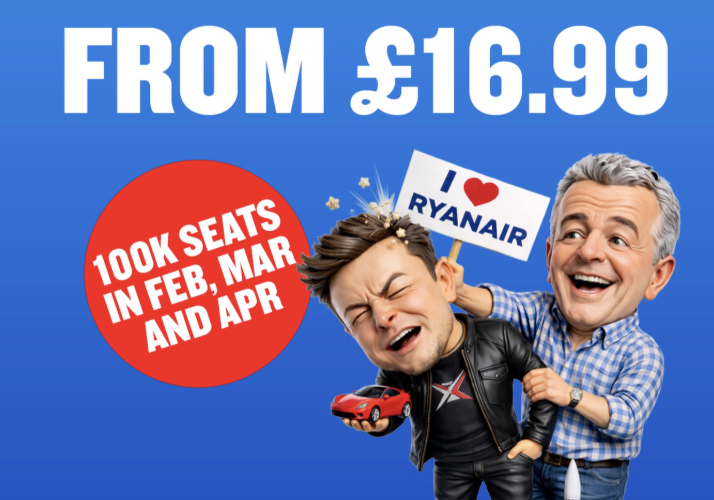
Ryanair didn’t defend itself. Instead, they grabbed the insult and turned it into a campaign, just as they’ve done before. Thus was born the “Big Idiot Sale”: a flash sale whose main sales argument was Musk’s “idiot” comment.
This is pure newsjacking. A brand takes the hottest topic of the moment, exploits it, and draws attention to itself. Plus, it gets sales and profits without having to invest large sums in traditional media channels. This is Ryanair controversial marketing at its finest.
Campaign Description: “The Big Idiot Sale” and Thanking Elon Musk
The campaign centered on a simple but bold visual: a caricature of Elon Musk and one of Michael O’Leary alongside sharp headlines like “Thanks Elon” and price offers starting at £16.99. The message was simple: Now we’re making a sale out of this. Elon gave us free advertising, now let’s make sales from it.
The visual language was deliberately raw and meme-like: caricatures, large headlines, and social media screenshots. No excessive design was used; the emphasis was on provocation. The campaign ran mainly on X, plus TikTok and Facebook, and directed interested parties to Ryanair’s website.
The target audience was price-conscious travelers. Ryanair’s direct, humorous, and “we’re not going to dress it up” style works for them.
Earlier Examples of Provocative Campaigns
There are other earlier examples where things are said directly and provocative ads are made from them, drawing widespread attention to the company.
“Partygate” and Boris Johnson’s Checklist (December 2021)
When British Prime Minister Boris Johnson was accused of organizing banned parties during coronavirus restrictions, Ryanair posted a “Downing Street Party Checklist” on social media. This mocked the government’s confusing explanations (like “it was a work meeting,” “we didn’t know it was a party”). They offered travelers tickets in the style of “If you’re going to break the rules anyway, at least do it somewhere sunny.”
Result: the post quickly gained huge organic reach and made it into British media. It dominated British news and received free coverage in outlets like BBC, The Guardian, and Sky News.
Ryanair Controversial Marketing Strategy: Controversy as Fuel
Such campaigns are not one-offs. They are a systematic approach consisting of three main pillars:
Self-Deprecation and Honesty
Ryanair doesn’t strive to make a first-class impression of itself. Narrow seats and extra fees aren’t an embarrassing secret for them. They’re material to joke about and bring to the surface. On TikTok they play at self-irony about their own service: the plane “talks,” complains about passengers, or throws shade on itself. The result is a brand that feels human and honest. The complete opposite of a typical airline where everything is corporate polish and perfection.
Reactive Marketing or Newsjacking
Ryanair operates like a fast-response meme factory. Current politics, pop culture, sports results, or a celebrity tweet—they immediately seize the moment. They turn it into content that spreads on its own. This keeps them constantly visible without having to spend large sums on TV or outdoor media.
When a post flies, the “media coverage” gets free amplification on top. From Estonia, for example, Pakendikeskus uses a similar strategy. It’s somewhat difficult to measure the success of newsjacking in sales numbers. But a definite spike in visibility certainly has a positive effect on sales as well.
“Roasting” Customers
Traditional customer service says “the customer is king.” On Ryanair’s social media, the customer is often the butt of the joke instead. If someone complains about legroom, they get back a ruler-like, dry response. Or a hint that a pricier ticket with another company is always available.
It’s a risky approach. But it’s precisely this directness and entertaining sharpness that has brought them a loyal fanbase. Especially among Gen Z and millennials, who prefer more honest, less polite interaction.
Results and Impact of Ryanair Controversial Marketing
Although exact sales figures mostly stay within the company, the impact of Ryanair controversial marketing on brand visibility and business results is easy to notice. “Big Idiot Sale” spread quickly on social media. It garnered large amounts of organic shares and reached international press columns, including the New York Post, BBC, The Guardian, and Reuters. Plus, there was an over-the-top amount of memes and reactions. All of which kept Ryanair’s name in front of the public for days.
Key Metrics
More concrete numbers from a few channels did come through:
- Social Media: The original post garnered millions of views and tens of thousands of shares on X and TikTok alone.
- Media Coverage: The free media value would have cost tens of thousands of euros through traditional advertising. Since the campaign itself was the news, it essentially came free.
- Website Traffic: Traffic to Ryanair’s website increased noticeably during the campaign days. This pointed to direct interest in the ticket offers.
- Competitive Advantage: Although other budget airlines (like Wizz Air, easyJet) have similar pricing models, Ryanair’s marketing allows it to hold attention and outpace competitors. They don’t have to burn the same media budget.
- Brand Recognition: For many, Ryanair is synonymous with budget travel. Even if people complain about the service, they check Ryanair’s fares first.
- Profitability: According to Ryanair’s CFO, the conflict and campaign brought additional traffic and a 2–3% growth in bookings.
Despite (or partly thanks to) its controversial style, Ryanair sticks to an ultra-efficient budget airline model. Planes operate at high capacity. The entire system is built to keep volumes and costs under control.
Criticism
Ryanair controversial marketing, sharp humor and “on the edge” tone works in ads and on social media as long as it doesn’t conflict with trust. And here they’ve had some pretty concrete setbacks.
Ad Bans and Complaints
In the winter of 2021, the UK’s advertising regulator Advertising Standards Authority banned Ryanair’s “Jab & Go” ads after receiving 2,370 complaints. The argument was that the message gave the impression that a vaccine alone was enough to travel. The rules in effect at that time required negative tests and other requirements. The ASA found the ad misleading and banned it.
Ryanair’s earlier calendar and advertising campaigns have also repeatedly drawn attention because of their light-clothing and “bikini photo” aesthetic. This has been considered demeaning and inappropriate for years. It has brought repeated negative attention and complaints.
On environmental issues, there have also been conflicts. In 2020, the ASA found that Ryanair’s claims like “Europe’s lowest emissions airline / low CO2” were problematic in ads. The claims were misleading or insufficiently substantiated. Necessary background information was not clearly presented.
The critics’ main argument is straightforward: such a tightrope walk may be a visibility engine in the short term. But in the long run it eats away at trust. This is especially true when the topic is safety, crisis situations, or serious customer problems. Similarly, while e.l.f. Cosmetics used bold, provocative messaging successfully, and Monzo combined playful growth hacks with smart business strategy, they maintained stronger audience trust.
Lessons Learned from Ryanair Controversial Marketing
Brand identity must be in place. Ryanair knows exactly that it’s a budget airline. It doesn’t play premium airline or apologize for its business model (extra fees, basic service). This consistency makes the message understandable. It sets expectations clearly and reduces customer complaints.
Negative attention can be turned into sales if telling the story and communicating is under your control. The O’Leary vs Musk conflict showed that even an insult can become campaign fuel. But only if the brand dares to frame it in its favor and acts quickly.
Standing out is competitive advantage. In marketing, you don’t always have to be likeable. Ryanair’s humor and provocativeness are their signature. It draws attention and creates a clear character (though it annoys some people).
Speed wins more on social media than perfection. Reactive marketing works only if timing is precise. A quick post at the right moment brings reach and earned media. Funny content posted too late is simply late and goes unnoticed.
Impact doesn’t always come from the length of an ad or post, but from its sharpness. Long formats can work very well. But Ryanair proves that a single striking meme or short post can do the same job. The message is simple, recognizable, and shareable.
Frequently Asked Questions
Ryanair uses a deliberately provocative social media strategy that turns criticism, insults, and negative press into viral marketing moments. When Elon Musk called Ryanair’s CEO an ‘idiot,’ the airline turned it into a flash sale campaign, demonstrating how newsjacking and humor-based engagement can generate massive free publicity.
Ryanair’s social media team responds to trolls and critics with wit and self-deprecating humor, turning negative comments into viral content. This approach generates millions of impressions and engagements at virtually zero cost, making it one of the most effective airline social media strategies in the industry.
Newsjacking is a marketing tactic where brands quickly create content that ties into trending news stories or viral moments. Ryanair is a master of this approach, rapidly turning news events into promotional campaigns that feel timely and authentic rather than forced.
Related Reading on Shopping Scientists
The Science of Shopping Behavior: A Complete Guide | Liquid Death: Another Bold Marketing Playbook | e.l.f. Shook Corporate America with Bold Marketing