
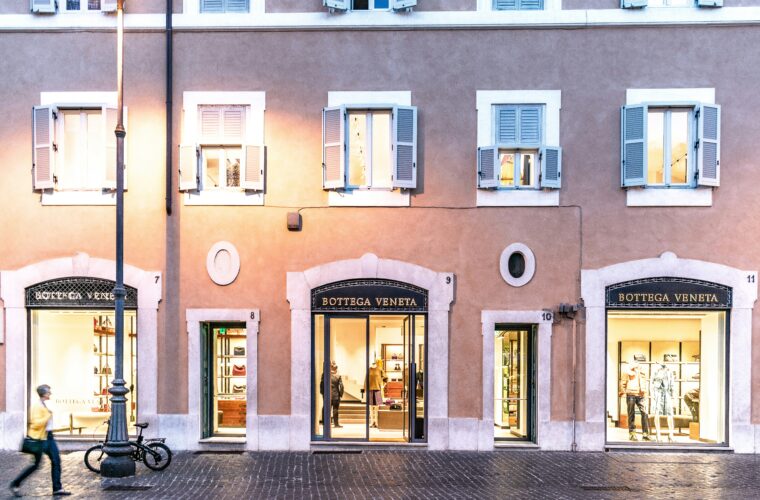
BOTTEGA VENETA BACKGROUND
Bottega Veneta is a luxury fashion brand founded in Italy in 1966. It is known especially for its high-quality leather goods, particularly handbags. Since 2001, it has been part of the French luxury group Kering, which also owns brands like Gucci, Saint Laurent, and Balenciaga.
Bottega Veneta has traditionally set itself apart from other luxury brands with its understated, logo-free design. The brand’s motto, “When your own initials are enough,” reflects its philosophy that true luxury doesn’t need to be flashy or covered in logos. Instead, the brand has focused on quality, craftsmanship, and materials, particularly through its iconic intrecciato woven leather technique and its signature bright Bottega Green color.
WHAT HAPPENED?
Table of Contents
A bold strategic move: total withdrawal from social media in 2021
In early 2021, Bottega Veneta shocked the fashion world by deleting all its official social media accounts—Instagram, Facebook, and Twitter. The move came at a time when most luxury brands were doubling down on their digital presence, especially during the pandemic, when physical stores were closed and digital channels had become more important than ever.
The decision came from then-Creative Director Daniel Lee, who had previously expressed skepticism about social media. He explained the move by saying that social media represented a “homogenization of culture” and overly simplified the thought process behind his work. In an interview with The Guardian, he stated:
“My work is the result of a lot of thinking and reflection, and social media oversimplifies that.”

AN UNOFFICIAL DIGITAL PRESENCE
After deleting its official accounts, Bottega Veneta’s visibility on social media didn’t disappear. Instead, celebrities, influencers, and fans kept the brand alive online by wearing and posting about its products. Kylie Jenner’s Christmas photo in a red sequined Bottega dress, Rosie Huntington-Whiteley’s Instagram posts, and content from Rihanna and Hailey Bieber spread further than any paid campaign could have.
Fashion show invites were extended to viral content creators like online icon Iman Khelif and TikTok creator Jooles Lebron. Their presence required no additional marketing—they brought visibility with them. The brand said nothing, yet everyone was talking about it.
One of the most interesting aspects of Bottega Veneta’s strategy was the rise of fan-run accounts that filled the vacuum left by the absence of official ones. These unofficial accounts became a key part of the brand’s digital presence.
@newbottega and other unofficial fan accounts
Among them is @newbottega, an Instagram account with 1.5 million followers, created by fashion student Laura Rossy. The account essentially acts as Bottega Veneta’s unofficial Instagram profile, sharing campaign photos and brand news first. While its creator has no formal ties to the brand, signs of collaboration exist, like invitations to shows and access to exclusive images. This suggests Bottega Veneta is aware of and may even tacitly support the account, seeing it as a way to maintain a digital presence without an official profile.
Other fan-run pages have emerged too, creating an unofficial network that spreads Bottega Veneta’s message and visuals organically.
GOALS AND RESULTS
The risks of this strategy were clear: reduced visibility, especially among younger audiences, difficulty launching new products, and potential drops in sales. But there were upsides too: standing out in an oversaturated digital space, boosting exclusivity and mystique, and building deeper customer relationships through alternative channels.
Despite today’s pressure to be “chronically online,” this approach appears to have worked. According to the Instagram account @databutmakeitfashion, during the first week of November 2024, Bottega Veneta’s brand popularity was 70% higher than its competitors.
Financial results showed growth, not decline
By 2022, Bottega Veneta’s annual revenue rose to €1.7 billion—a 16% increase from the previous year. In 2023, it hit €1.645 billion and €1.713 billion in 2024. Despite being absent from the most visible digital platforms, the brand became more valuable.
On Lyst’s hottest brands list, Bottega Veneta also climbed steadily: from 16th place in Q3 2019 to 4th in 2023. By late 2024, it held the 6th spot.
CRITICISM
While the decision to leave social media was bold and successful, critics question whether it was part of a long-term strategy or just a temporary experiment. The brand’s quiet return to social media—without explanation—raised questions about the clarity of its messaging. The initial silence, followed by partial reappearance, seemed contradictory and may suggest internal doubts about the strategy’s sustainability.
FUN FACT
After leaving social media in 2021, Bottega Veneta introduced a visually striking, curated digital magazine called Issue as its main digital channel—a counter to noisy platform-based content. Four minimalist issues were released that year, attracting significant attention.
Short-term, the Issue was a success and a hot topic in fashion circles. But over time, it proved too complex and resource-intensive. Its organic reach remained low, and the project faded out. When the Issue ended, the brand shifted focus to YouTube, where it now shares collection videos, campaign visuals, and fashion show footage. New content is rare, but every video is clearly thought out—no ads, but part of the brand’s aesthetic. No chatter, no explanations—just image, sound, and rhythm. Pure Bottega: quiet, yet confident.
LESSONS LEARNED
Lack of social media doesn’t mean invisibility. A well-positioned brand can reject the digital noise and gain even more loyalty, trust, and prestige.
Social media is a tool, not an obligation. Bottega Veneta showed that silence can be marketed—if it’s done consciously and in line with brand identity.
A “less is more” approach can be an effective strategy, especially in the luxury sector, where exclusivity and mystery are core values.
A brand doesn’t need to be actively present on social media to stay visible online. Instead, it can rely on ambassadors and fans to spread its message more authentically and organically.
Local market nuances matter. Bottega Veneta’s decision to remain on China’s Weibo platform shows that global brands must adapt their strategies to regional conditions and consumer behavior.
Today, it’s clear: Bottega Veneta’s strategy is not about being visible everywhere—it’s about being deliberately selective. In Kering Group’s 2025 strategy, the brand has a defined role: to be the luxury house that doesn’t follow the rules of mass communication, but writes its own.